 Add to Chrome
 Add to Firefox
 Add to Edge
EvalVerse: Pipeline-Aware and Expert-Calibrated Benchmarking for Professional Cinematic Video Generation
May 22, 2026
The rapid evolution of generative video foundation models has propelled the field toward professional-grade cinematic synthesis. To achieve such demanding quality, the community transitions towards Reinforcement Learning (RL) and agentic workflows. However, reliable evaluation has emerged as a critical bottleneck. Existing benchmarks predominantly evaluate ''whether it is right'' (basic prompt-following) while fundamentally neglecting ''whether it is good'' (cinematic quality, acting, and aesthetics). Furthermore, current automated metrics lack the domain-specific rigor required to provide trustworthy signals, creating a severe credibility gap between human aesthetic perception and machine scoring. To bridge this gap, we introduce EvalVerse, a comprehensive, pipeline-aware, and expert-calibrated evaluation framework. We treat video generation assessment not merely as an engineering task, but as a core scientific problem: the systematic digitization of subjective cinematic expertise. First, we organize domain knowledge into an evaluation taxonomy aligned with the professional filmmaking workflow (pre-production, production, and post-production). Second, we distill human expert judgments into a curated dataset with large-scale human annotations. Third, we inject this knowledge into Vision-Language Models (VLMs) through an expert-calibrated fine-tuning strategy, enabling the VLM to perform explicit Chain-of-Thought reasoning. Compared to previous works, EvalVerse not only retains compatibility with foundational ''rightness'' metrics, but also significantly expands the criteria to ''goodness'' and broaden the task coverage to complex multi-shot sequencing and audio-visual integration. Consequently, by providing granular diagnostic signals, EvalVerse transcends a static leaderboard and establishes a fundamental infrastructure for future work, such as reward models and evaluator agent.

Learning Spatiotemporal Sensitivity in Video LLMs via Counterfactual Reinforcement Learning
May 21, 2026Video large language models (Video LLMs) achieve strong benchmark accuracy, yet often answer video questions through shortcuts such as single-frame cues and language priors rather than by tracking spatiotemporal dynamics. This issue is exacerbated in RL post-training, where correctness-only rewards can further reinforce shortcut policies that obtain high reward without tracking video dynamics. We address this by asking a controlled counterfactual question: if the visual world changed while the question remained fixed, should the answer change or stay the same? Based on this view, we propose \textbf{Counterfactual Relational Policy Optimization (CRPO)}, a dual-branch RL framework for improving \emph{spatiotemporal sensitivity}. CRPO constructs counterfactual videos through horizontal flips and temporal reversals, trains on both original and counterfactual branches, and introduces a \textbf{Counterfactual Relation Reward (CRR)} between their answers. CRR encourages answers to change for dynamic questions and remain unchanged for static questions. This cross-branch constraint makes it difficult for shortcut policies to be consistently rewarded across both branches. To evaluate this property, we introduce \textbf{DyBench}, a paired counterfactual video benchmark with 3,014 videos covering reversible dynamics, moving direction, and event sequence, together with a strict pair-accuracy metric that prevents fixed-answer shortcuts from inflating scores. Experiments show that CRPO outperforms prior RL methods on spatiotemporal-sensitive evaluations while maintaining competitive general video performance. On Qwen3-VL-8B, CRPO improves DyBench P-Acc by +7.7 and TimeBlind I-Acc by +8.2 over the base model, indicating improved spatiotemporal sensitivity rather than stronger reliance on static shortcuts. The project website can be found at https://ddz16.github.io/crpo.github.io/ .
MLLMs Know When Before Speaking: Revealing and Recovering Temporal Grounding via Attention Cues
May 21, 2026Video temporal grounding (VTG), which localizes the start and end times of a queried event in an untrimmed video, is a key test of whether multimodal large language models (MLLMs) understand not only what happens but also when it happens. Although modern MLLMs describe video content fluently, their timestamp predictions remain unreliable, while existing remedies either require costly post-training on temporal annotations or rely on coarse training-free heuristics. In this work, we probe the cross-modal attention of MLLMs and uncover a perception-generation gap. Our key finding is that MLLMs often know the target interval during prefill, but lose this signal when generating the final answer. In the prefill stage, a sparse set of attention heads, which we call \emph{Temporal Grounding Heads} (TG-Heads), concentrates query-to-video attention on the ground-truth interval. During autoregressive decoding, however, the answer tokens shift attention away from this interval toward visually salient but query-irrelevant segments. This observation motivates an inference-time read-then-regenerate framework. We first convert TG-Head prefill attention into a debiased frame-level relevance signal and extract the high-attention interval it highlights. We then re-invoke the MLLM with visual context restricted to this interval, using video cropping or attention masking to suppress distractors. Without parameter updates and architectural changes, our framework consistently improves MiMo-VL-7B, Qwen3-VL-8B, and TimeLens-8B on three VTG benchmarks, with gains of up to +3.5 mIoU. The project website can be found at https://ddz16.github.io/mllmsknowwhen.github.io/.
Sheet as Token: A Graph-Enhanced Representation for Multi-Sheet Spreadsheet Understanding
May 07, 2026Workbook-scale spreadsheet understanding is increasingly important for language-model-based data analysis agents, but remains challenging because relevant information is often distributed across multiple sheets with heterogeneous schemas, layouts, and implicit relationships. Existing retrieval-augmented approaches typically decompose spreadsheets into rows, columns, or blocks to improve scalability; however, such chunk-centric representations can fragment worksheets into isolated text spans and weaken global sheet-level semantics. We propose Sheet as Token, a graph-enhanced framework that treats each worksheet as a unified semantic unit for multi-sheet spreadsheet retrieval. Our method extracts schema-aware records from sheet names, column headers, representative values, and layout features, and encodes each worksheet into a compact dense token. Given a natural-language query, a Graph Retriever constructs a query-specific candidate graph over sheet tokens using semantic, query-conditioned, schema-consistency, and shape-compatibility relations, and composes these channels through a multi-stage graph transformer to retrieve supporting sheet sets. Experiments on a constructed multi-sheet spreadsheet corpus show that sheet-level tokenization learns stable representations, and that graph-enhanced cross-sheet reasoning improves listwise retrieval over a shallow graph baseline with limited additional graph-side computation. These results suggest that sheet-level tokenization is a promising abstraction for scalable multi-sheet spreadsheet understanding.
LR-SGS: Robust LiDAR-Reflectance-Guided Salient Gaussian Splatting for Self-Driving Scene Reconstruction
Mar 13, 2026Recent 3D Gaussian Splatting (3DGS) methods have demonstrated the feasibility of self-driving scene reconstruction and novel view synthesis. However, most existing methods either rely solely on cameras or use LiDAR only for Gaussian initialization or depth supervision, while the rich scene information contained in point clouds, such as reflectance, and the complementarity between LiDAR and RGB have not been fully exploited, leading to degradation in challenging self-driving scenes, such as those with high ego-motion and complex lighting. To address these issues, we propose a robust and efficient LiDAR-reflectance-guided Salient Gaussian Splatting method (LR-SGS) for self-driving scenes, which introduces a structure-aware Salient Gaussian representation, initialized from geometric and reflectance feature points extracted from LiDAR and refined through a salient transform and improved density control to capture edge and planar structures. Furthermore, we calibrate LiDAR intensity into reflectance and attach it to each Gaussian as a lighting-invariant material channel, jointly aligned with RGB to enforce boundary consistency. Extensive experiments on the Waymo Open Dataset demonstrate that LR-SGS achieves superior reconstruction performance with fewer Gaussians and shorter training time. In particular, on Complex Lighting scenes, our method surpasses OmniRe by 1.18 dB PSNR.
Utonia: Toward One Encoder for All Point Clouds
Mar 03, 2026We dream of a future where point clouds from all domains can come together to shape a single model that benefits them all. Toward this goal, we present Utonia, a first step toward training a single self-supervised point transformer encoder across diverse domains, spanning remote sensing, outdoor LiDAR, indoor RGB-D sequences, object-centric CAD models, and point clouds lifted from RGB-only videos. Despite their distinct sensing geometries, densities, and priors, Utonia learns a consistent representation space that transfers across domains. This unification improves perception capability while revealing intriguing emergent behaviors that arise only when domains are trained jointly. Beyond perception, we observe that Utonia representations can also benefit embodied and multimodal reasoning: conditioning vision-language-action policies on Utonia features improves robotic manipulation, and integrating them into vision-language models yields gains on spatial reasoning. We hope Utonia can serve as a step toward foundation models for sparse 3D data, and support downstream applications in AR/VR, robotics, and autonomous driving.
Any3D-VLA: Enhancing VLA Robustness via Diverse Point Clouds
Jan 31, 2026Existing Vision-Language-Action (VLA) models typically take 2D images as visual input, which limits their spatial understanding in complex scenes. How can we incorporate 3D information to enhance VLA capabilities? We conduct a pilot study across different observation spaces and visual representations. The results show that explicitly lifting visual input into point clouds yields representations that better complement their corresponding 2D representations. To address the challenges of (1) scarce 3D data and (2) the domain gap induced by cross-environment differences and depth-scale biases, we propose Any3D-VLA. It unifies the simulator, sensor, and model-estimated point clouds within a training pipeline, constructs diverse inputs, and learns domain-agnostic 3D representations that are fused with the corresponding 2D representations. Simulation and real-world experiments demonstrate Any3D-VLA's advantages in improving performance and mitigating the domain gap. Our project homepage is available at https://xianzhefan.github.io/Any3D-VLA.github.io.
ProPy: Building Interactive Prompt Pyramids upon CLIP for Partially Relevant Video Retrieval
Aug 26, 2025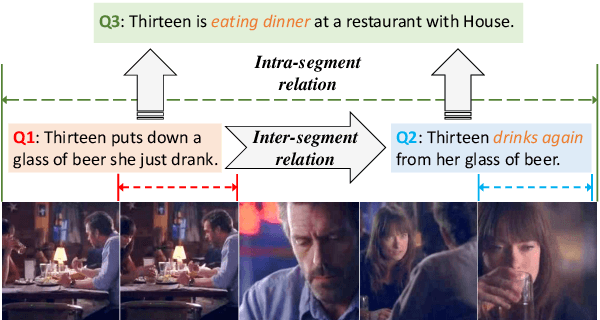
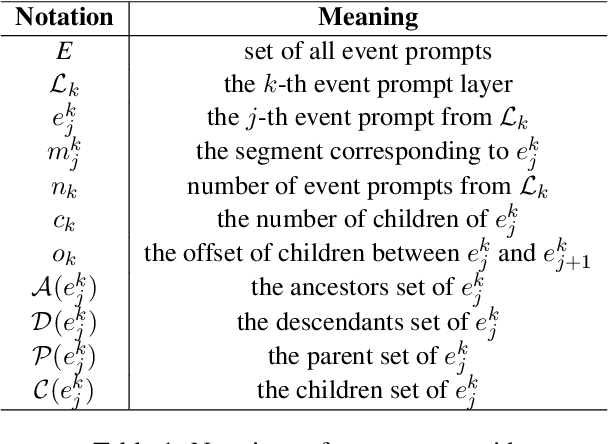
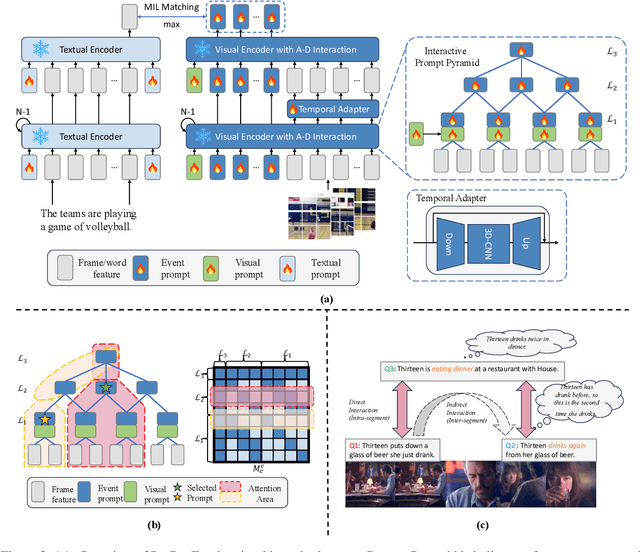
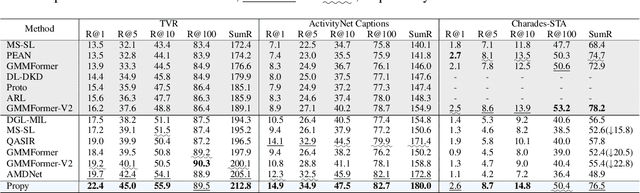
Partially Relevant Video Retrieval (PRVR) is a practical yet challenging task that involves retrieving videos based on queries relevant to only specific segments. While existing works follow the paradigm of developing models to process unimodal features, powerful pretrained vision-language models like CLIP remain underexplored in this field. To bridge this gap, we propose ProPy, a model with systematic architectural adaption of CLIP specifically designed for PRVR. Drawing insights from the semantic relevance of multi-granularity events, ProPy introduces two key innovations: (1) A Prompt Pyramid structure that organizes event prompts to capture semantics at multiple granularity levels, and (2) An Ancestor-Descendant Interaction Mechanism built on the pyramid that enables dynamic semantic interaction among events. With these designs, ProPy achieves SOTA performance on three public datasets, outperforming previous models by significant margins. Code is available at https://github.com/BUAAPY/ProPy.
Self-supervised Preference Optimization: Enhance Your Language Model with Preference Degree Awareness
Sep 26, 2024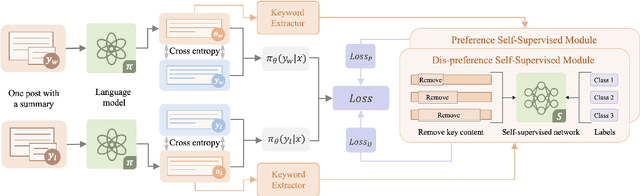
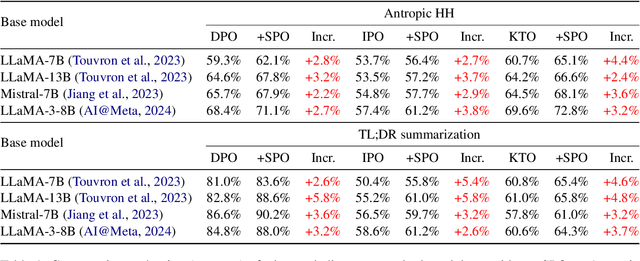
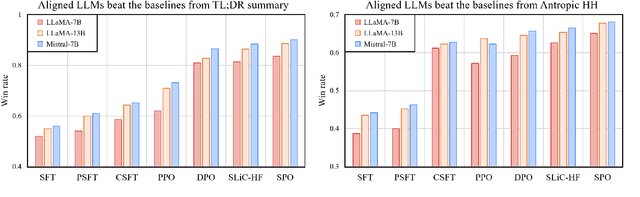
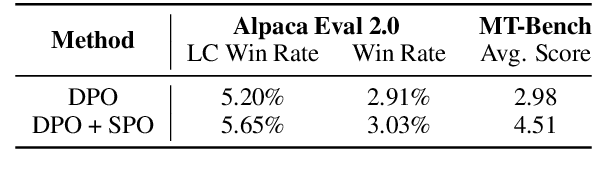
Recently, there has been significant interest in replacing the reward model in Reinforcement Learning with Human Feedback (RLHF) methods for Large Language Models (LLMs), such as Direct Preference Optimization (DPO) and its variants. These approaches commonly use a binary cross-entropy mechanism on pairwise samples, i.e., minimizing and maximizing the loss based on preferred or dis-preferred responses, respectively. However, while this training strategy omits the reward model, it also overlooks the varying preference degrees within different responses. We hypothesize that this is a key factor hindering LLMs from sufficiently understanding human preferences. To address this problem, we propose a novel Self-supervised Preference Optimization (SPO) framework, which constructs a self-supervised preference degree loss combined with the alignment loss, thereby helping LLMs improve their ability to understand the degree of preference. Extensive experiments are conducted on two widely used datasets of different tasks. The results demonstrate that SPO can be seamlessly integrated with existing preference optimization methods and significantly boost their performance to achieve state-of-the-art performance. We also conduct detailed analyses to offer comprehensive insights into SPO, which verifies its effectiveness. The code is available at https://github.com/lijian16/SPO.
Understanding Public Safety Trends in Calgary through data mining
Jul 30, 2024This paper utilizes statistical data from various open datasets in Calgary to to uncover patterns and insights for community crimes, disorders, and traffic incidents. Community attributes like demographics, housing, and pet registration were collected and analyzed through geospatial visualization and correlation analysis. Strongly correlated features were identified using the chi-square test, and predictive models were built using association rule mining and machine learning algorithms. The findings suggest that crime rates are closely linked to factors such as population density, while pet registration has a smaller impact. This study offers valuable insights for city managers to enhance community safety strategies.